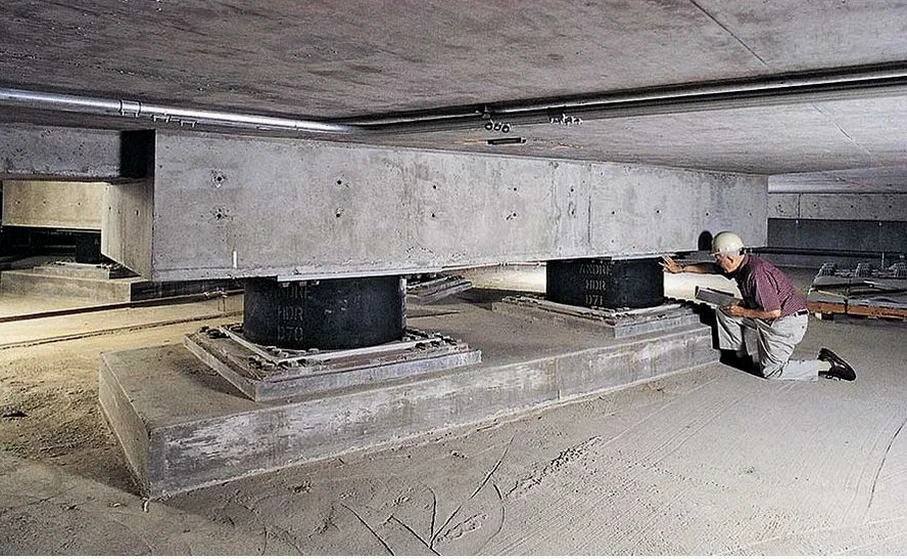
Clarington's evolution from a collection of agricultural hamlets into a key Greater Toronto Area municipality brought major infrastructure investments—the Darlington Nuclear Generating Station, expanded GO Transit corridors, and new healthcare facilities. Each project sits on the complex glacial stratigraphy that defines the north shore of Lake Ontario. Dense till overlying shale bedrock, interspersed with sand lenses and silt pockets, creates a seismic environment where conventional fixed-base design quickly becomes uneconomical. The 2015 NBCC spectral acceleration values for the region demand careful attention to site class effects. Incorporating base isolation transforms the structural response, decoupling the superstructure from ground motion and reducing inter-story drift by 40 to 60 percent compared to fixed-base alternatives. Our seismic microzonation studies across Clarington confirm that site amplification varies considerably between the lakeshore plain and the Oak Ridges Moraine uplands. These findings directly influence isolator selection, displacement capacity, and the moat detailing requirements that govern performance during a design-level earthquake. We also integrate findings from MASW surveys to constrain Vs profiles at depths exceeding 30 meters, ensuring the isolation system is tuned to actual ground conditions rather than generic code defaults.
Effective isolation period targeting 2.5 to 3.0 seconds shifts the structure away from the dominant 0.2-0.5 second spectral peaks typical of Clarington's firm soil sites.
Methodology and scope
Local considerations
NBCC 2015 Article 4.1.8 and the referenced CSA S832 standard establish the performance objectives that govern base-isolated structures in Canada. Clarington's post-disaster buildings—hospitals, emergency operations centers, and energy infrastructure—must remain fully operational after a 2,475-year return period event. The biggest technical risk lies in moat wall impact. If the isolation gap is underestimated, or if the surrounding backfill settles unexpectedly during the earthquake, the superstructure can pound against the retaining elements, generating forces far beyond the design assumptions. A secondary concern is the stability of the isolation layer under extreme wind loads before the system yields—a condition that requires careful tuning of the lead core size to avoid nuisance cycling during storms off Lake Ontario. Our team addresses these risks through probabilistic seismic hazard analysis that incorporates the unique seismotectonic setting of southern Ontario, where moderate-magnitude events at distances of 50 to 100 kilometers dominate the hazard rather than near-field pulses.
Applicable standards
NBCC 2015 (National Building Code of Canada, Part 4), CSA S832-14 (Seismic risk reduction of operational and functional components), CSA S16-19 (Design of steel structures, Annex M for seismic isolation), ISO 22762-1:2018 (Elastomeric seismic-protection isolators), ASCE/SEI 7-22 Chapter 17 (Seismic isolation provisions, reference standard)
Associated technical services
Nonlinear Time-History Analysis & Isolator Specification
Full 3D modeling in ETABS and PERFORM-3D using site-specific ground motion suites matched to the NBCC uniform hazard spectrum for Clarington. Includes bidirectional coupling effects, stability checks under maximum considered earthquake displacement, and detailed bearing schedule preparation with quality assurance testing protocols.
Peer Review & Construction Phase Isolation Inspection
Independent third-party review of the isolation design per NBCC requirements for post-disaster structures. On-site verification of bearing installation tolerances, moat cover detailing, and utility crossings across the isolation plane. We also supervise prototype and production testing at the manufacturer's facility.
Typical parameters
Frequently asked questions
Does base isolation make sense for a four-story building in Clarington, or is it only for larger structures?
The decision depends on the occupancy category and performance goals rather than height alone. For essential facilities like healthcare clinics or municipal emergency centers, the post-earthquake functionality requirement under NBCC often justifies isolation even at three to four stories. The added construction cost—typically four to seven percent of the structural budget—is weighed against downtime losses and contents damage that a fixed-base design would sustain. For standard commercial buildings on Class C sites, conventional ductile design is generally more cost-effective; we evaluate this on a case-by-case basis with comparative cost-benefit analysis.
What maintenance does a base isolation system require over the building's life?
HDRB and lead-rubber bearings are passive devices with no moving mechanical parts that require lubrication. The primary maintenance task is periodic inspection of the isolation moat to ensure debris, ice, or unauthorized modifications have not bridged the seismic gap. We recommend visual inspection every two years and a detailed engineering review every ten years. The elastomer compounds specified for Clarington's climate include anti-ozonant and antioxidant additives that protect against aging, with a design service life exceeding 50 years when protected from direct UV exposure.
What is the typical cost range for a base isolation design package in Clarington?
For a complete design package covering nonlinear time-history analysis, isolator specification, peer review coordination, and construction phase inspection, professional fees typically range from CA$5,440 to CA$12,040 depending on the structural complexity and number of isolators. This does not include the bearing fabrication cost, which is procured directly by the contractor based on our performance specification. We provide a fixed-fee proposal after reviewing the architectural drawings and geotechnical report.