You see it all the time on Clarington job sites. A contractor brings in what looks like decent granular, but nobody has the paperwork to prove it will hold up under traffic. That is where our lab steps in. We run the California Bearing Ratio test following ASTM D1883-21 to give you a defensible number for pavement thickness design. The CBR value ties directly into the granular base and subgrade modulus, which the MTO and municipal specs in Clarington require before any asphalt goes down. For projects near the Lake Ontario shoreline, where the native silty clay can soften quickly with moisture, we often pair the CBR with a Proctor compaction curve to nail the right density at the right moisture, and grain size analysis to confirm the gradation envelope.
A soaked CBR below 3 percent on a clay subgrade means you are building a pavement on a sponge. We flag it early so you can budget for treatment, not patching.
Methodology and scope
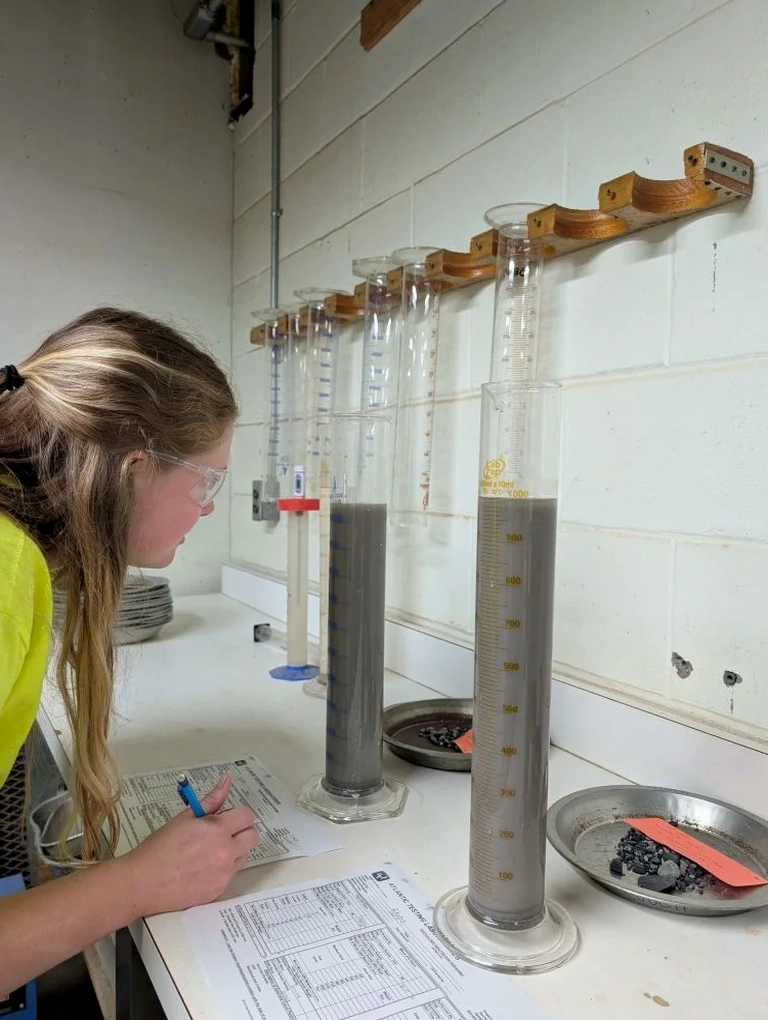
Local ground factors
We worked on a commercial plaza off Highway 2 where the geotech report called for a CBR of 15 on the subbase. The imported granular met spec on paper, but after a wet fall, the lab CBR dropped to 8 because the fines content was higher than the sieve report showed. The pavement design had to be revised, adding two inches of asphalt at a cost nobody planned for. That is the real risk in Clarington, especially east of Bowmanville where the overburden is a mix of silty sand and clay lenses. If you skip the lab CBR or rely on a field DCP correlation alone, you can end up with a pavement that ruts in the first spring thaw. We test the material you actually plan to use, compacted the way you plan to compact it, and give you a CBR number that holds up under municipal review.
Relevant standards
The laboratory CBR testing procedures in Clarington adhere to ASTM D1883-21, ASTM D698/D1557 (Proctor), and the referenced MTO LS-700 series standards.
Associated technical services
Soaked CBR Testing
Standard 96-hour soak for subgrade and subbase materials per ASTM D1883, with load-penetration curves and corrected CBR values at 0.1 and 0.2 inch penetration.
Unsoaked CBR for Granular Base
Immediate bearing ratio test for open-graded granulars where saturation is not the controlling condition, often requested for temporary haul roads.
CBR plus Proctor Package
Combined compaction curve and CBR on the same material sample to lock in density, moisture, and bearing strength for pavement design submittals.
Typical parameters
Common questions
What is the difference between soaked and unsoaked CBR?
A soaked CBR simulates the material after saturation, which is the critical case for pavement design in Clarington's freeze-thaw climate. An unsoaked CBR tests the material at its compaction moisture without soaking and is used for materials that will not see prolonged saturation, like some base course aggregates under covered areas.
How long does a lab CBR test take in your lab?
A standard soaked CBR takes five working days: one day for compaction and setup, four days of soaking, and the final day for the penetration test and reporting. Unsoaked CBR results can be ready within two days.
Do you pick up samples in Clarington?
We do. We can collect bulk samples from your site in Courtice, Bowmanville, Newcastle, or anywhere in Clarington. A 50 kg bag is typically enough for one CBR point with the corresponding Proctor. We just need a clean, representative sample from the lift you want tested.
What CBR value do municipalities around here require?
Most municipal specs in Clarington and Durham Region call for a minimum soaked CBR of 3 to 5 percent on the prepared subgrade and 20 to 30 percent on the granular base, depending on the traffic loading. We can run the test and flag whether your material meets the contract specification before you place it.