One mistake we see too often in Clarington is relying on shallow spread footings without verifying what lies beneath the glacial till. The surface looks compact, but a few meters down you can hit a soft clay lens left by Lake Iroquois, and suddenly the settlement you calculated becomes meaningless. Pile foundation design in Clarington is not about over-engineering every project; it is about knowing where the risk zones are. We combine local borehole data with in-situ permeability testing to assess drainage around the pile shaft, because a saturated clay layer behaves very differently from the dense till above it. The goal is a pile design that transfers load to competent bearing stratum without surprises.
A pile design in Clarington succeeds or fails based on what you do with the soft layer at 4 to 7 meters depth; ignore it and settlement will find it.
Methodology and scope
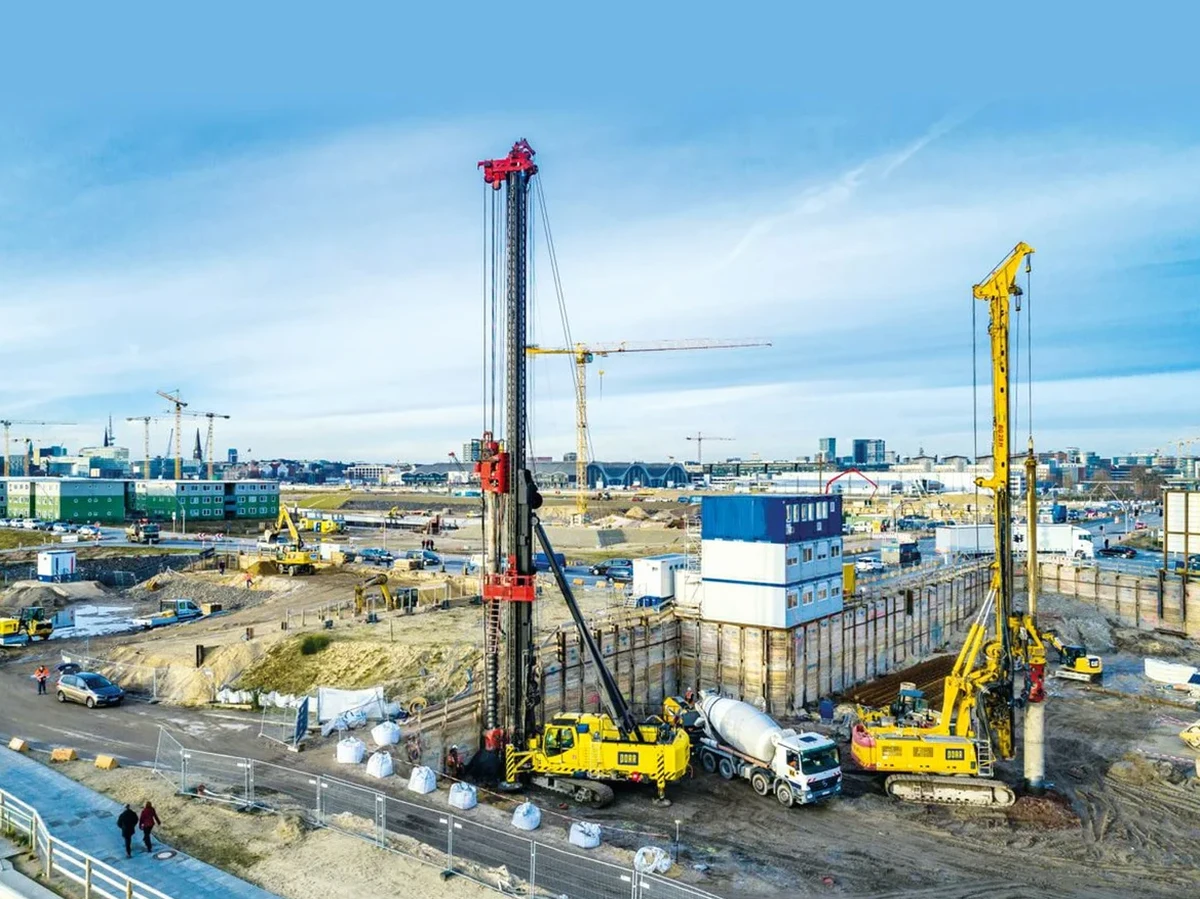
Local considerations
One pattern we have observed repeatedly in Clarington is differential settlement between pile-supported building cores and grade-supported slab-on-grade areas. The pile group settles very little, but the slab area over the compressible upper soils can drop 15 to 20 millimeters over five years. That creates a step at door thresholds and can crack partition walls. Our design practice addresses this explicitly: we either extend piles under the entire footprint in sensitive structures, or we detail a structural slab with enough stiffness to bridge the transition zone. Another local concern is frost heave on the upper portion of piles in unheated perimeter areas; the NBCC frost depth of 1.2 meters is our minimum for pile cap embedment, and we specify bond breakers where seasonal ground movement is expected.
Applicable standards
NBCC 2020 (National Building Code of Canada), CSA A23.3:19 (Design of Concrete Structures), CSA S6:19 (Canadian Highway Bridge Design Code, where applicable), ASTM D1143/D1143M (Standard Test Methods for Deep Foundation Elements Under Static Axial Compressive Load)
Associated technical services
Residential and Light Commercial Pile Design
Custom pile layouts for single-family homes, townhouse blocks, and low-rise commercial buildings in Clarington. We optimize pile count and depth using site-specific soil parameters, avoiding the conservative assumptions of prescriptive tables. Deliverables include pile schedule, axial and lateral capacities, and construction monitoring requirements.
Heavy Structure and Industrial Pile Engineering
Deep foundation design for warehouses, municipal facilities, and agricultural structures with heavy floor loads or vibration sensitivity. We design pile groups for large column loads, analyze group settlement interaction, and specify dynamic testing requirements where driven piles are proposed. Lateral analysis includes wind, seismic, and equipment thrust loads.
Typical parameters
Frequently asked questions
How do you determine the right pile length for a Clarington site?
Pile length is determined by the depth to competent bearing stratum. We drill a borehole or advance a CPT sounding at the building location, log the soil and rock layers, and identify the elevation where end-bearing resistance or skin friction can safely support the design load. In Clarington, this often means penetrating the soft Lake Iroquois clay and founding in the dense till or shale beneath it, typically 8 to 14 meters deep.
What is the cost range for pile foundation design in Clarington?
Design fees for pile foundation engineering in Clarington typically range from CA$2,130 to CA$8,880, depending on the complexity of the structure, number of pile load cases, and whether lateral or seismic analysis is required. This covers the geotechnical design report, pile schedule, and construction specifications.
Do you need a full geotechnical investigation before designing piles?
Yes. Pile design without site-specific soil data is speculation. At minimum, one borehole or CPT sounding per building area is required to establish the stratigraphy and soil strength parameters. For larger projects, multiple investigation points are needed to capture lateral variability across the site.
How do you account for seismic loads in Clarington pile designs?
Seismic design follows NBCC 2020 provisions. We determine the site class from shear wave velocity measurements or SPT N-values, then apply the spectral acceleration values for Clarington. Pile lateral capacity under seismic loading is analyzed using p-y springs, and we check for liquefaction-induced loss of skin friction where loose saturated sands are present.