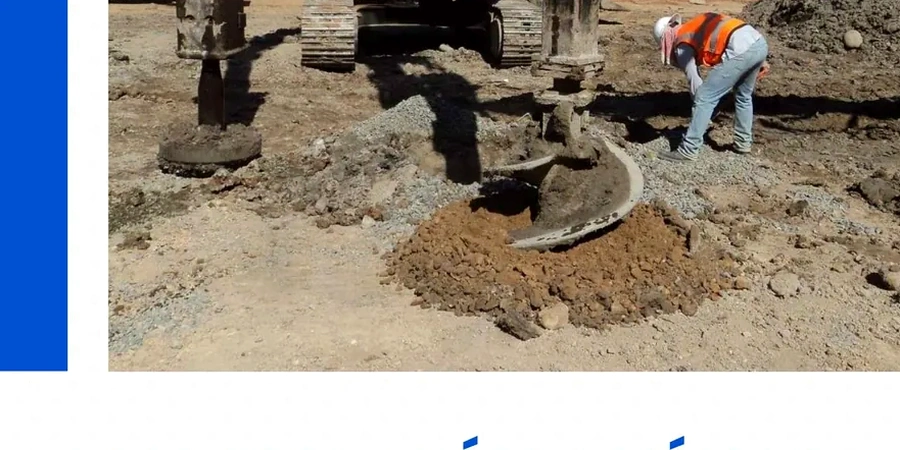
A warehouse expansion near the 401 in Bowmanville hit refusal at 1.2 meters during standard SPTs last spring—the underlying silty clay just couldn’t support conventional footings without excessive differential settlement. The project engineer had two choices: deep piles or ground improvement. Stone column design ended up being the faster, more cost-effective path. For sites across Clarington’s glacial till plains and post-glacial lakebed deposits, vibro-replacement columns transfer structural loads past the compressible layer and into the bearing stratum below. The design phase is where the whole thing succeeds or fails—column diameter, grid spacing, aggregate gradation, and depth all need to match the actual stratigraphy. We don’t run vibroflots ourselves; we provide the engineering package that tells the contractor exactly where to place them, including verification testing protocols so the installed columns actually perform as modeled.
A stone column grid isn’t just a pattern—it’s a composite foundation where column spacing controls settlement reduction and load transfer efficiency simultaneously.
Methodology and scope
Local considerations
Clarington’s development arc from a rural township into a commuter-heavy GTA node has pushed construction into areas that were farmland or marsh thirty years ago—places where the soil profile was never meant to carry structural loads. The risk of skipping a proper stone column design isn’t just settlement; it’s differential settlement that tears apart slab-on-grade floors and misaligns crane rails in industrial buildings. In the Courtice and Newcastle corridors, we’ve seen fill layers over buried organic silt that lose strength when saturated. A poorly designed column grid in those conditions can create a stiff inclusion effect that actually concentrates stress into the weak matrix between columns. The design has to be conservative enough to work, but sharp enough to avoid over-engineering that kills the budget. That’s why we run at least two sensitivity analyses per project—varying the modulus of the stone and the in-situ soil stiffness to bracket the expected performance envelope.
Applicable standards
ASTM D2487 – Standard Practice for Classification of Soils for Engineering Purposes (Unified Soil Classification System), ASTM D1194 (withdrawn, reference) / ASTM D1195/D1196 – Plate Load Test methods for verification, NBCC 2015 Part 4 – Structural Design provisions for foundations on improved ground, FHWA-NHI-16-072 – Ground Improvement Methods (Volume II, Vibro-Replacement), CSA A23.3 – Design of Concrete Structures (for transition mats over stone columns)
Associated technical services
Stone Column Feasibility & Preliminary Design
Review of geotechnical baseline data, unit cell settlement modeling using Priebe or FE methods, liquefaction mitigation check where applicable, and a go/no-go recommendation for vibro-replacement versus alternates like rigid inclusions or deep soil mixing.
Detailed Design & Construction QA Specifications
Complete design package with column grid layout, diameter and depth schedule, aggregate gradation per ASTM D448, installation sequence notes for sensitive soils, and field verification protocols—plate load tests, modulus checks, and post-installation CPT correlation where required.
Typical parameters
Frequently asked questions
What soil conditions in Clarington make stone columns a suitable choice?
Stone columns work well in the soft to firm silty clays and loose silty sands common across Clarington’s glacial and lacustrine deposits. The key parameter is undrained shear strength—we look for Su values between roughly 15 and 50 kPa. Below that, bulging failure becomes hard to control without reducing column spacing, and above that, vibro-replacement may not densify the soil effectively. Sites with organic silt layers or peat lenses require special scrutiny because creep settlement can continue long after primary consolidation. A thorough stratigraphic profile from SPT or CPT soundings is essential before committing to the design.
How do you verify that installed stone columns meet the design intent?
Verification typically combines modulus-based tests and direct load tests. We specify zone load tests or individual column plate load tests per ASTM D1194 methodology, measuring load-deflection response up to 150% of design working load. For larger sites in Clarington, we also use post-installation CPT soundings through the column and adjacent soil to confirm densification and column continuity. The acceptance criteria are tied to the settlement reduction factor used in the design—if the field modulus falls short, we adjust the grid or add columns before structural loads are applied.
Can stone columns be used for liquefaction mitigation in seismic zones?
Yes, and it’s a relevant question for Clarington given the regional seismicity from the Western Quebec Seismic Zone. Stone columns provide drainage paths that reduce excess pore pressure buildup during cyclic loading, and the densification effect increases the cyclic resistance ratio of the surrounding soil. The design for liquefaction mitigation follows the NCEER/Youd-Idriss framework adapted for stone column-treated ground, with a target factor of safety against liquefaction typically above 1.3 for post-treatment conditions. We specify the column spacing to achieve the required pore pressure dissipation rate based on the site’s permeability and anticipated earthquake magnitude.
What does stone column design cost for a typical project in Clarington?
Design fees for stone column ground improvement in Clarington generally fall between CA$2,150 and CA$7,880 depending on the building footprint, number of column types, and whether finite element modeling is required. A straightforward warehouse pad with uniform loading and a single column type sits at the lower end; a multi-story structure with variable column loads, irregular geometry, and liquefaction analysis pushes toward the upper range. The design package always includes the construction specification and verification testing criteria—those aren’t add-ons.
How does the design account for long-term settlement after stone column installation?
Long-term settlement is handled through the unit cell consolidation analysis built into the Priebe method or through coupled FE consolidation models when the loading is staged. The stone column acts as a vertical drain, accelerating primary consolidation of the surrounding clay—in Clarington’s silty clays, we often see 90% consolidation within weeks rather than months. Secondary compression (creep) is assessed separately using the Cα/Cc ratio from oedometer tests on undisturbed samples. If creep settlement exceeds the project tolerance, we adjust the area replacement ratio or consider a preloading surcharge before final column installation. More info.