Drive north from the Lake Ontario shoreline near Newcastle into the Oak Ridges Moraine around Orono, and the ground beneath the tires changes dramatically. What starts as soft, water-saturated silts and clays near the lake transitions into dense glacial till and sandy deposits within a few kilometers. A conventional borehole program captures this transition at discrete points. CPT soundings map it continuously, revealing the exact depth where the stratigraphy shifts. For engineers working on the Port Granby legacy site or new subdivisions pushing into the moraine, the cone penetration test provides the vertical resolution that standard drilling often misses. Pairing CPT data with targeted SPT drilling at key locations combines the speed of cone soundings with the physical samples needed for lab classification, giving Durham Region projects a solid geotechnical baseline.
A single CPTU sounding gives you cone tip resistance, sleeve friction, and equilibrium pore pressure all in one continuous log. It is three data streams from one push.
Methodology and scope
Local ground factors
Winters in Clarington are not just cold; the freeze-thaw cycle penetrates 1.2 meters into the ground, while spring snowmelt swells the creeks that drain the moraine. Saturated fine sands and silts that felt stable during an August site visit can lose effective stress rapidly when groundwater rises in March. CPT soundings catch this because the piezocone measures excess pore pressure during penetration, and the dissipation test that follows shows how quickly the soil can drain. A dissipation curve that flattens slowly in a silty sand near the Enniskillen escarpment signals a layer that could liquefy under seismic loading. The 2015 Oshawa-area earthquake, though moderate at magnitude 4.3, reminded consultants across Durham that intraplate seismicity is real. Cone data feeds directly into the NCEER and updated Boulanger-Idriss liquefaction triggering procedures, turning a raw tip resistance profile into a factor of safety against cyclic softening.
Relevant standards
The following standards and references are employed: ASTM D5778-20 – Standard Test Method for Electronic Friction Cone and Piezocone Penetration Testing of Soils, ASTM D6067-17 – Standard Practice for Using the Electronic Piezocone Penetrometer for Environmental Site Characterization, NCEER/NSF 1997 – Liquefaction Resistance of Soils: Summary Report (Youd et al.) / Boulanger & Idriss (2014) CPT-Based Triggering Procedure, NBCC 2020 – Part 4, Seismic Hazard and Site Classification using Vs and CPT data, and CSA A23.
Associated technical services
Seismic CPTu with Shear Wave Velocity
A seismic cone with a triaxial geophone measures the arrival time of shear waves generated at the surface every 1.0-meter push increment. The resulting Vs profile assigns an NBCC site class directly from measured data rather than proxy correlations, which matters in the Oak Ridges Moraine where impedance contrasts between dense till and underlying shale create complex amplification patterns.
CPTu Dissipation and Pore Pressure Profiling
At predetermined depths the penetration stops and the piezocone records the decay of excess pore pressure over time. The t50 value from the dissipation curve feeds consolidation and permeability estimates. For the soft Lake Iroquois clays south of Highway 401, this data refines settlement calculations and preloading timelines without waiting for oedometer results.
Typical parameters
Common questions
How much does a CPT test cost in Clarington?
Does CPT replace boreholes for a Clarington building permit?
CPT provides continuous stratigraphic data but does not recover physical soil samples. Most municipalities in Durham Region, including Clarington, accept CPT as part of the geotechnical submission when paired with at least one borehole or test pit for material classification and groundwater monitoring installation. The combination of test pits for shallow inspection and CPT for deep profiling satisfies both the Building Code and the consultant's need for defensible design parameters.
Can you push through the dense till layers common north of Highway 2?
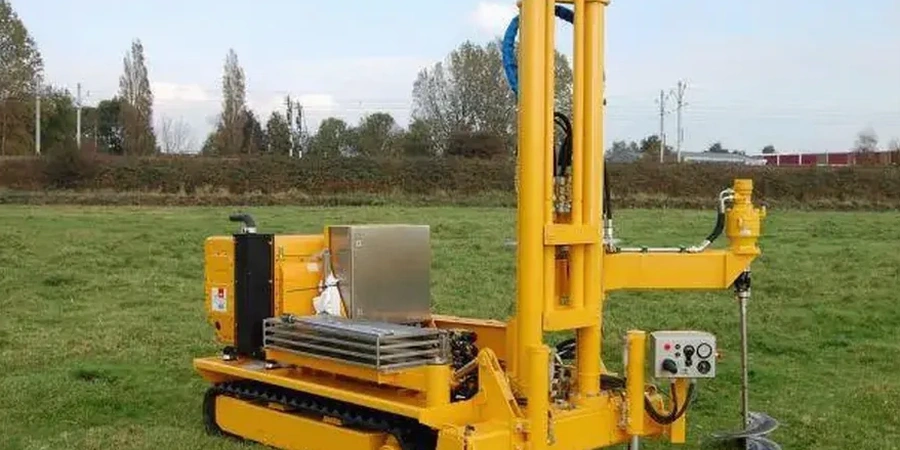
The Halton Till and underlying Newmarket Till in northern Clarington can reach tip resistances exceeding 40 MPa. Our 20-tonne CPT rig with a reinforced push system handles these layers, but refusal may occur on cobble-rich lenses or boulder pavements. When the cone reaches practical refusal depth, we pre-drill through the obstruction with a hollow-stem auger and resume CPT below, or we complement the profile with an SPT borehole at the same location.
How long does a CPT field program take on a typical Clarington site?
A three-sounding program with 20-meter depths and two dissipation tests per sounding completes within a single working day, including rig setup, traffic control if needed, and demobilization. Seismic CPT adds roughly 30 minutes per sounding due to the surface shear wave source repositioning. The digital data file is delivered within 48 hours, and the interpreted report with soil behavior type charts and liquefaction analysis follows in five business days.