The 2020 National Building Code of Canada sets clear performance expectations for temporary and permanent earth retention systems, and nowhere in the Municipality of Clarington is this more pertinent than where glacial stratigraphy transitions from dense Halton Till to softer glaciolacustrine deposits. Designing an anchor system here requires reconciling the NBCC’s seismic provisions with the CSA A23.3 anchorage requirements, particularly when working near the Lake Ontario shoreline where groundwater levels fluctuate seasonally by over a metre. The team routinely specifies both active (pre-stressed) anchors for deformation-sensitive structures and passive (grouted) anchors for less critical retaining scenarios across Clarington’s diverse terrain. A well-executed anchor program in this region depends on integrating field pull-out test data with laboratory shear strength results, often supplementing the investigation with in-situ permeability testing to confirm grout injection parameters before finalizing the bond length calculations.
Bond length is not a catalogue value in Clarington—it is a function of the in-situ stress history and the grout-to-ground adhesion confirmed through on-site suitability testing.
Methodology and scope
Local ground factors
A hydraulic rotary-percussive drill rig equipped with a duplex casing system is the standard deployment for anchor installation in Clarington, specifically where caving conditions are encountered in the saturated sand units below the Bowmanville Creek floodplain. The primary risk during construction is grout loss into these unconfined granular lenses, which can reduce the effective bond zone and lead to a premature pull-out failure if not detected by continuous grout take monitoring. The team mitigates this by specifying staged grouting with thixotropic mixes that limit flow into permeable strata while maintaining injection pressure below the overburden fracture threshold. For permanent anchors in Clarington, the long-term relaxation behaviour of the steel tendon under sustained load is accounted for through a lock-off procedure that incorporates anticipated seating loss and elastic shortening of the free length, ensuring the residual force after transfer remains within the serviceability limit.
Relevant standards
The design and installation of active and passive anchor systems for excavation support in Clarington shall comply with NBCC 2020 (Division B, Part 4), CSA A23.3:19 Annex D—Anchorage, PTI DC35.1-14—Recommendations for Prestressed Rock and Soil Anchors, ASTM A416/A416M—Steel Strand, Uncoated Seven-Wire for Prestressed Concrete, and OPSS.MUNI 206—Geotechnical Investigations and Monitoring.
Associated technical services
Active (Pre-stressed) Anchors
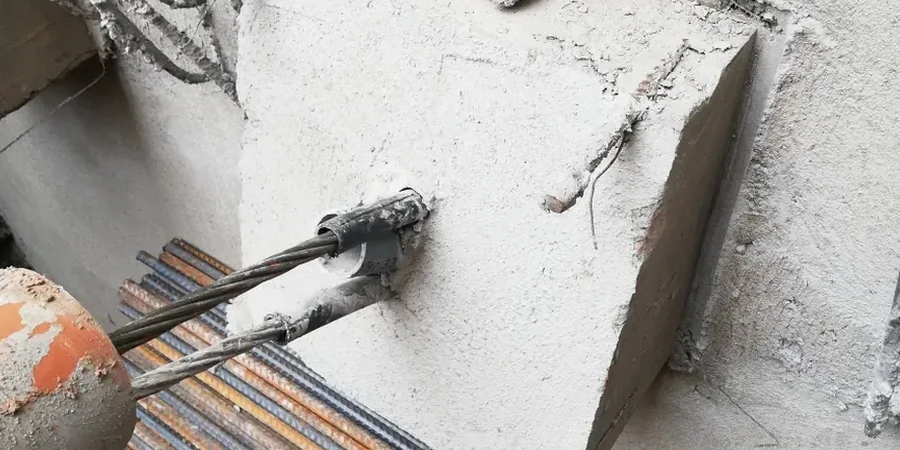
For deep excavations adjacent to existing infrastructure or where lateral displacement must remain below 15 mm, we design pre-stressed multi-strand anchors with double corrosion protection. Each anchor is proof-tested to 133% of the design load in accordance with PTI DC35.1, and the lock-off sequence is calibrated to compensate for wedge seating loss measured during the first three load cycles.
Passive (Grouted) Anchors
Where deformation tolerance allows and the retained height is less than 5 metres, passive threadbar anchors installed in a single-stage grouting operation provide a cost-effective tieback solution. The bond length is verified through pull-out tests on sacrificial anchors at the start of the program, allowing the design to be adjusted before production drilling commences.
Typical parameters
Common questions
What is the difference between active and passive anchors for a retaining wall in Clarington?
Active anchors are pre-stressed after grouting to apply a compressive force to the retained soil mass, which minimizes lateral wall movement during excavation. Passive anchors are not tensioned; they mobilize resistance only when the wall begins to deflect, making them suitable for lower retained heights or where minor deformation is acceptable. The choice in Clarington often depends on proximity to adjacent structures and the stiffness of the retained soil.
How does the local geology in Clarington affect anchor bond length?
The glacial stratigraphy south of the Oak Ridges Moraine includes dense Halton Till, which can develop high grout-to-ground adhesion with relatively short bond lengths, and softer glaciolacustrine silts that require longer bonds or post-grouting. Site-specific pull-out tests are essential because the transition between these units can occur within a few vertical metres, and the bond capacity cannot be reliably predicted from SPT N-values alone.
What is the typical cost range for an anchor design and testing program in Clarington?
What corrosion protection is required for permanent anchors in Ontario?
Permanent ground anchors in Clarington must comply with Class I corrosion protection as defined by PTI DC35.1, which requires double encapsulation: a corrugated plastic duct grouted inside the borehole, plus an individual sheathing over each strand within the free length. The anchorage head at the wall face must also be fully encapsulated within a protective cap filled with grease or grout to prevent atmospheric corrosion over the design life.
How is anchor performance verified during construction?
Verification follows a three-stage process: first, sacrificial test anchors are loaded to failure to confirm the ultimate bond capacity; second, each production anchor undergoes a proof test to 133% of the design load with creep monitoring over a 10-minute hold period; third, a subset of anchors is re-checked with lift-off tests after lock-off to confirm that the residual pre-stress falls within the acceptance window specified in the design.