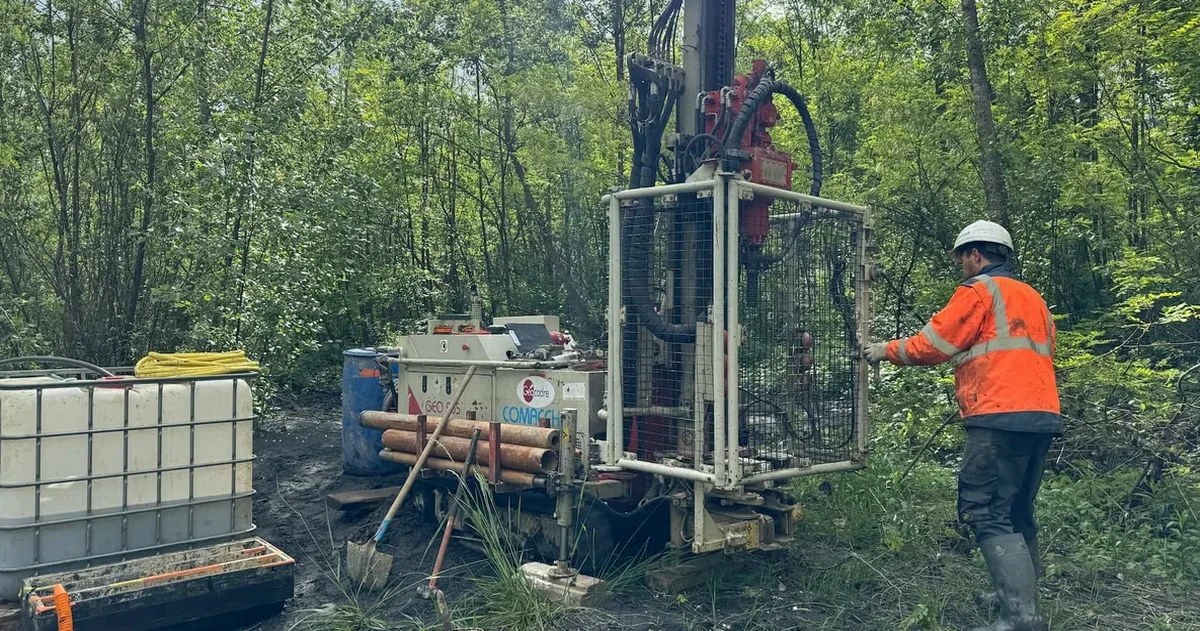
A truck-mounted CME-75 drill rig with hollow-stem augers works through the silty clay till that underlies much of Clarington, extracting Shelby tube samples at depths where the gray matrix transitions from stiff to very stiff consistency. The recovered cores go directly into sealed sleeves, preserving natural moisture content for transport to the laboratory. In Clarington, where the Oak Ridges Moraine deposits meet the Lake Ontario shoreline, the stratigraphy shifts abruptly over short distances — a condition that demands systematic sampling and careful logging rather than extrapolation from regional maps. The soil mechanics study defines shear strength, compressibility, and permeability parameters that feed directly into foundation design, slope stability analysis, and excavation support planning. For projects near the Bowmanville Creek floodplain, where organic silt layers appear within the upper three meters, we often recommend supplementing the investigation with in-situ permeability testing to quantify vertical drainage rates before selecting a foundation type.
Undisturbed sampling through the weathered crust, followed by consolidation and shear testing at the specific stress levels the foundation will impose, converts stratigraphic uncertainty into quantifiable design parameters.
Methodology and scope
Local ground factors
The geotechnical contrast between the northern concession roads and the lakeshore subdivisions illustrates the risk of applying uniform design assumptions across Clarington. North of Concession Road 5, the Halton Till forms a dense, overconsolidated matrix with undrained shear strengths routinely exceeding 100 kPa — a material that supports strip footings at shallow depth with minimal settlement. South of the CN rail corridor, however, the near-surface stratigraphy shifts to softer glaciolacustrine deposits interbedded with organic silt seams, where undrained strengths can drop below 40 kPa within the upper four meters. A soil mechanics study that samples and tests both formations under their respective in-situ stress conditions prevents the costly error of designing southern foundations with northern parameters. Differential settlement across a single building footprint becomes the controlling failure mode when the bearing stratum varies in stiffness by more than 50% over distances of 15 meters or less. Consolidation settlement calculations, derived from the compression index and initial void ratio measured in the laboratory, predict the magnitude and time rate of settlement under the design load — values that must remain within the NBCC 2015 serviceability limits for total and differential movement.
Relevant standards
The geotechnical investigation incorporates ASTM D2435 for one-dimensional consolidation properties via incremental loading, ASTM D4767 for consolidated undrained triaxial compression testing of cohesive soils, ASTM D3080 for direct shear testing under consolidated drained conditions, NBCC 2015 Division B Part 4 for structural design, and CSA A23.3 for concrete foundation embedment and soil-structure interaction analysis.
Associated technical services
Laboratory Testing Program for Strength and Compressibility
Consolidation, direct shear, and triaxial testing on undisturbed specimens recovered from Clarington boreholes. Each test runs under stress ranges matched to the design foundation loads, with pore pressure monitoring where groundwater conditions influence effective stress paths. Index testing — Atterberg limits, natural water content, and grain-size distribution — accompanies every performance test to classify the material and validate specimen consistency across the sampling depth.
Parameter Interpretation and Geotechnical Design Summary
Reduction of laboratory data to design parameters: drained and undrained shear strength, preconsolidation pressure, compression and swelling indices, coefficient of consolidation, and permeability estimated from consolidation time curves. The deliverable includes bearing capacity calculations, settlement predictions under service loads, and lateral earth pressure coefficients for retaining structures, all referenced to the specific stratigraphic units encountered at the Clarington site.
Typical parameters
Common questions
How long does a full soil mechanics study take from drilling to final report in Clarington?
The typical turnaround is four to five weeks. Field sampling takes one to two days depending on borehole depth and number. Consolidation testing requires the most time — each load increment runs 24 hours, and a complete test with five to seven increments plus rebound spans roughly 10 days. Triaxial and direct shear tests add another week. Report preparation, including parameter interpretation and design recommendations, takes five to seven business days after all laboratory data is complete.
What soil parameters does the study provide for foundation design?
The study delivers effective stress shear strength parameters (c' and φ') from consolidated-drained direct shear or consolidated-undrained triaxial testing with pore pressure measurement. It also provides undrained shear strength (Su) for short-term loading conditions, compression index (Cc) and recompression index (Cr) for settlement calculations, preconsolidation pressure to determine stress history, and coefficient of consolidation (cv) for time-rate-of-settlement predictions. Lateral earth pressure coefficients for active, at-rest, and passive conditions are derived from the friction angle for retaining wall design.
What does a soil mechanics study cost for a typical residential project in Clarington?
Do you need both consolidation and shear testing, or is one sufficient?
Both are typically necessary because they address different failure modes. Consolidation testing quantifies settlement magnitude and rate — a serviceability limit state concern. Shear testing defines the strength envelope used for bearing capacity and slope stability — ultimate limit state concerns. Omitting either leaves a gap in the design basis. For lightly loaded structures on dense till where settlement is demonstrably negligible, shear testing alone may suffice, but this determination requires engineering judgment based on site-specific stratigraphy and load magnitude.
How does the laboratory testing account for the variable soil conditions across Clarington?
The testing program is stratified by lithologic unit rather than depth alone. When boring logs identify distinct layers — for example, a weathered crust over intact till over glaciolacustrine silt — each unit receives its own set of index and performance tests. Specimens are selected from the midpoint of each representative stratum to avoid transition zones. This approach produces unit-specific parameters that reflect the actual variability, rather than a single averaged value that may not represent any single layer accurately.