Most retaining wall failures in Clarington don’t happen because the concrete was bad. They happen because someone ignored the groundwater table perched in the Halton Till, or assumed a friction angle that doesn’t match what’s actually under the footing. We’ve seen walls lean, crack, and slide — and almost every time, the geotechnical investigation was skipped to save a week on the schedule. When you’re dealing with the silty clay plains south of Highway 2 or the moraine deposits near the Oak Ridges trail, generic designs don’t cut it. Our retaining wall design process starts with a proper understanding of the subsurface, including seasonal high water levels, frost penetration down to 1.2 metres, and the real earth pressures the wall will face. For sites with questionable bearing capacity, we often pair the design with a footing investigation to confirm the numbers before a single bucket goes in the ground.
A retaining wall is only as good as the soil you never see. In Clarington’s till-and-silt terrain, that means understanding where the water actually sits, not where the textbook says it should be.
Methodology and scope
- Lateral earth pressure distribution based on site-specific triaxial or direct shear results, not textbook defaults
- Drainage detailing that accounts for clay lenses trapping water behind the wall — a classic issue in the Port Darlington area
- Reinforcement sizing per CSA A23.3, with cover requirements adjusted for freeze-thaw exposure
- Construction-phase monitoring triggers when the wall exceeds 3 metres in height or is within 5 metres of a property line
Local ground factors
The contrast between a subdivision in Courtice and a rural lot up in Enniskillen tells you a lot about risk. Courtice sits on the glaciolacustrine deposits — fine-grained, water-sensitive, and prone to softening if you don’t control the excavation floor. Enniskillen, on the other hand, is till over shale bedrock, where the wall loading interacts with a much stiffer profile but brings its own challenge: rock socketing for taller cantilevers. If you apply the same design across both areas, one of them fails. In Courtice, the real danger is a rotational slip through the softened zone behind the heel. In Enniskillen, it’s differential frost heave if the footing isn’t embedded past the weathered shale contact. We adjust the analysis method, the drainage strategy, and the construction sequencing based on which part of Clarington we’re working in. That’s not over-engineering — that’s just knowing the ground.
Relevant standards
The design must conform to the Ontario Building Code (OBC) 2012, Division B, Part 4, for structural design, and to CSA A23.3:19 for the design of concrete structures.
Associated technical services
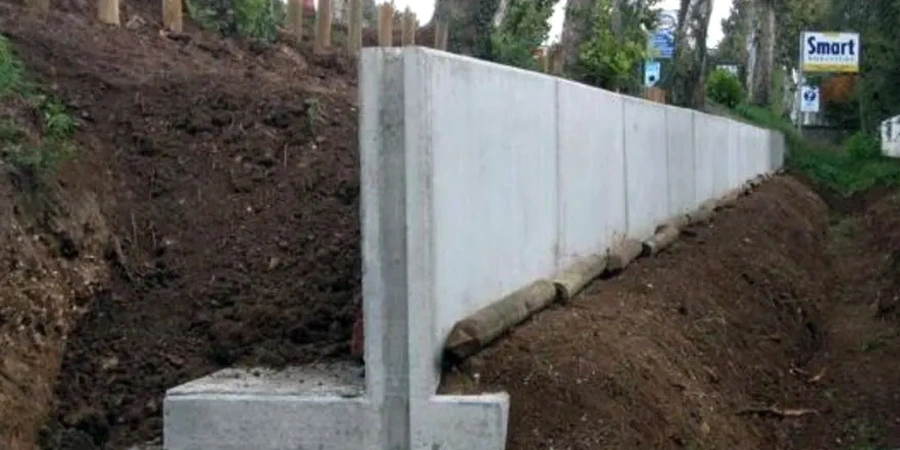
Cantilever and gravity wall design
Full structural and geotechnical design for reinforced concrete cantilever walls, gravity block walls, and segmental retaining wall systems. Includes overturning, sliding, bearing, and internal stability checks with site-specific soil parameters from field investigation and lab testing.
MSE and slope-reinforced walls
Design of mechanically stabilized earth walls and hybrid systems where space constraints or cut-fill transitions demand a more integrated solution. We coordinate reinforcement layout, facing type, and drainage with the contractor’s preferred system — whether it’s geogrid, welded wire, or modular block.
Typical parameters
Common questions
What does a retaining wall design cost in Clarington?
Do I need a building permit for a retaining wall in Clarington?
Yes, the Municipality of Clarington requires a building permit for any retaining wall exceeding 1.0 metre in height, measured from the bottom of the footing to the top of the wall. Walls under 1.0 metre that support a surcharge — like a driveway or a neighbouring structure — may also trigger permit requirements. Our design package includes the sealed engineering drawings and calculations that the building department will ask for as part of the permit application.
How do you handle groundwater behind the wall?
We design the drainage system based on the highest observed groundwater level from site investigation, not just the seasonal average. In Clarington’s silty till, that often means a continuous granular drain behind the wall, filtered to prevent fines migration, with weep holes or a collector pipe discharging to a positive outlet. If the wall is below the water table for part of the year, we add hydrostatic pressure to the loading model and check the drain capacity for a 25-year storm event.