A crew placing engineered fill off Concession Road 3 had the nuclear gauge ready, but the clayey silt from the Lake Ontario plain was reading too wet for the gauge to be reliable. In that scenario, the fallback is the sand cone. The sand cone density test gives you a direct volume measurement that doesn't care about the chemistry of the fill, which matters a lot in Clarington where tills and glaciolacustrine deposits shift from sand to fat clay within a hundred metres. We run the procedure per ASTM D1556 and CSA A23.3 compaction requirements, using calibrated Ottawa sand and a field balance checked every morning. Whether the lift is under a slab in Bowmanville or a stormwater pond in Newcastle, the numbers have to hold up to the geotechnical report.
A sand cone test doesn't extrapolate—it measures the hole you just dug, period. That directness is what makes it the referee method on a Clarington fill job.
Methodology and scope
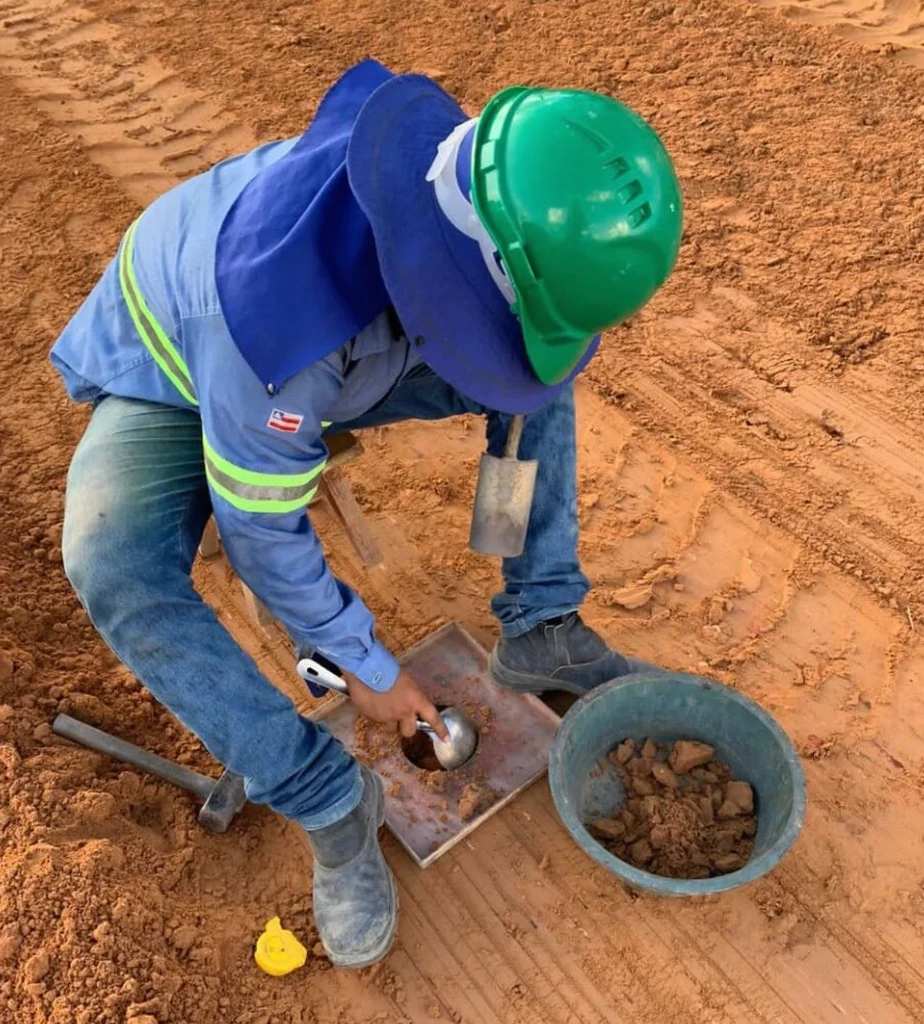
Local ground factors
Clarington's construction season runs May through November, and the humidity from Lake Ontario can keep a fill surface damp well into the afternoon. Running a sand cone on a wet subgrade gives you a false density reading because the sand sticks to the sidewalls of the hole instead of filling it uniformly. We wait for the lift to dry back or scrape the top 25 mm before testing. Another risk is crushed stone with angular particles—if the gradation is open, the calibration sand can migrate into the voids, overstating the volume and understating the density. On those jobs we switch to a water-replacement method or cross-check with a CPT test on the deeper layers. The biggest call we make in Clarington is knowing when the sand cone is the right tool and when the soil conditions are working against it.
Relevant standards
The field density testing program in Clarington adheres to ASTM D1556 for in-place soil density determination via the sand-cone method, CSA A23.3 for compaction acceptance criteria in concrete design, the National Building Code of Canada 2015 Part 4, and Proctor compaction reference standards ASTM D698 and D1557.
Associated technical services
Compaction Control Package
Sand cone field density paired with lab Proctor curves (standard and modified). We test fills under footings, slabs, road subgrades, and utility trenches across Clarington, delivering same-day percent compaction reports.
Nuclear Gauge Cross-Calibration
When the nuclear gauge is the primary tool, we run periodic sand cone tests as the referee method to validate the gauge calibration against the actual soil being placed.
Typical parameters
Common questions
How much does a sand cone density test cost in Clarington?
How many sand cone tests do I need per lift?
The Ontario Building Code and most geotechnical reports call for one test per 300 m² of compacted lift, with a minimum of three tests per lift regardless of area. For narrow utility trenches in Clarington, we often test every 30 linear metres.
Can you run a sand cone test on gravel with large stones?
ASTM D1556 limits the method to soils with maximum particle size under 50 mm. If the Clarington fill has cobbles or open-graded crushed stone larger than that, the sand cone tends to give unreliable results because the calibration sand invades the voids. We recommend a water-replacement test or nuclear gauge with proper correction factors for those materials.
How long does a sand cone test take on site?
A single test point takes about 20 to 30 minutes from hole excavation to density calculation, assuming the soil isn't excessively wet. We weigh the recovered soil on a portable balance and run a Speedy moisture test on the spot so the percent compaction number is available before the next lift starts.