The glacial till plains underlying Clarington Municipality, deposited during the Wisconsinan glaciation, present a mix of silty sand, clayey silt, and occasional boulder lenses that complicate fill placement. Achieving uniform compaction in these heterogeneous soils without a defined moisture-density relationship is essentially guesswork. Whether the project involves a residential subdivision in Courtice, a commercial pad near Highway 401, or backfilling a trench in Newcastle, the Proctor test provides the target parameters contractors need. The municipality sits within the Lake Ontario basin, where seasonal groundwater fluctuations soften the upper weathered crust, making compaction control even more critical. Standard effort (ASTM D698) suits most residential earthworks, while modified effort (ASTM D1557) applies where higher load-bearing capacity is required, such as under heavily trafficked pavement structures or industrial slab-on-grade installations.
A Proctor number without a matching field density test tells you nothing about actual compaction achieved on site.
Methodology and scope
Local considerations
The most common mistake we see on Clarington sites is a contractor using a single moisture target across multiple fill types without running new Proctor tests when the material changes. The till deposits here can shift from a lean clay to a silty sand within a few hundred meters of a subdivision cut. A Proctor curve developed for one material is meaningless for another. The second common error is applying modified Proctor compaction energy with standard Proctor acceptance criteria, which gives a false sense of security on density readings. Overcompaction of moisture-sensitive clay fill above optimum also leads to shear planes and long-term heave. A CBR test on the compacted subgrade ties the Proctor result directly to pavement design, confirming that the achieved density actually delivers the assumed bearing capacity.
Explanatory video
Applicable standards
ASTM D698-12: Standard Proctor, ASTM D1557-12: Modified Proctor, ASTM D4718-15: Oversize Correction, MTO LS-701/LS-702 (Ontario provincial variants)
Associated technical services
Standard & Modified Proctor Testing
Laboratory determination of maximum dry density and optimum moisture content using ASTM D698 or D1557. We test cohesive and granular fill, including oversize correction when gravel content exceeds 15%. Report includes the full moisture-density curve and zero air voids line for specification development.
Field Compaction Verification Package
Combined Proctor reference curve development with on-site nuclear gauge or sand cone density testing. We provide lift-by-lift relative compaction results against the Proctor target, helping earthwork supervisors adjust roller passes and moisture conditioning in real time.
Typical parameters
Frequently asked questions
What does Proctor testing cost in the Clarington area?
A single-point standard Proctor (ASTM D698) generally runs between CA$160 and CA$200 per sample, while the modified Proctor (ASTM D1557) ranges from CA$200 to CA$250. Multi-sample projects or combined field and lab packages can reduce the per-test cost. All prices depend on the number of points and whether oversize correction is needed.
How many Proctor tests do I need for my site?
At minimum, one Proctor per distinct material type encountered. On Clarington sites with variable glacial till, we typically recommend one test for every 2,000 to 5,000 cubic meters of placed fill, or whenever visual classification of the borrow source changes. A single reference curve cannot cover both clay-rich and sand-rich zones.
What is the difference between standard and modified Proctor?
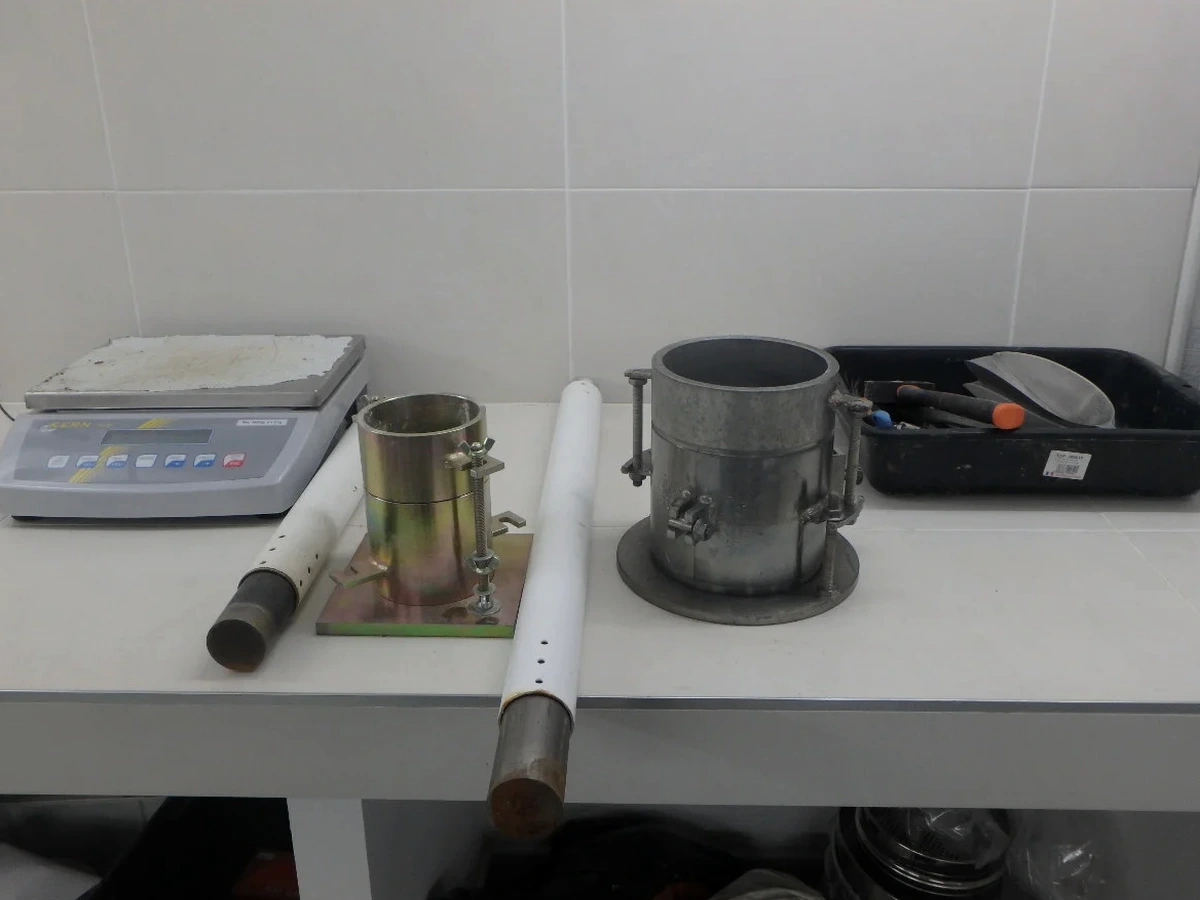
The standard Proctor (ASTM D698) applies 600 kJ/m³ of compactive energy in three layers with a 2.5 kg hammer. The modified Proctor (ASTM D1557) applies 2,700 kJ/m³ in five layers with a 4.54 kg hammer. Modified effort produces a higher maximum dry density at a lower optimum moisture content and is specified for heavy-duty pavements, airport runways, and deep fill where settlement tolerance is tight.