Designing a raft or mat foundation in Clarington goes far beyond a simple slab on grade. The municipality sits on the former Lake Iroquois plain, meaning we routinely encounter layered deposits of silt, clay, and sand that behave very differently under load than the rockier terrain north of Highway 7. NBCC 2020 and CSA A23.3 govern how we approach thickness, reinforcement, and serviceability, but local soil conditions dictate the real-world performance. Our team has worked across Courtice, Bowmanville, and Newcastle, and we consistently see the same thing: differential settlement risk is the primary concern. A properly designed raft foundation distributes building loads across a wide footprint, reducing pressure on the naturally variable subgrade. When the upper soils show low bearing capacity, we often combine the mat design with a ground improvement program or evaluate how deep foundations compare for the specific lot.
A raft foundation in Clarington's glacial deposits is a settlement-control solution, not just a bearing-capacity solution.
Methodology and scope
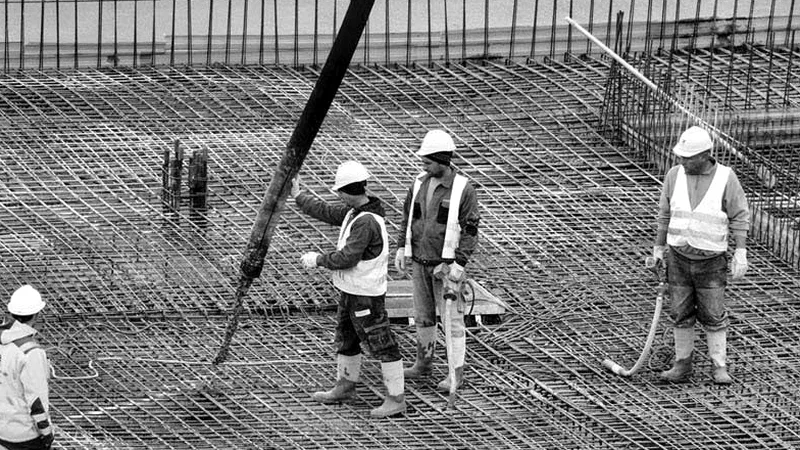
Local ground factors
The soil investigation for raft design in Clarington typically starts with a track-mounted drill rig, capable of advancing through the stiff upper crust of desiccated clay and into the softer saturated layers below. The primary risk we manage is underestimating the thickness of compressible silty clay lenses. If a raft is designed assuming uniform subgrade conditions but encounters a buried organic pocket or a looser sand lens, differential settlement can exceed predictions and crack walls or disrupt door frames. We mitigate this by spacing boreholes no more than 25 meters apart and extending them to at least twice the width of the mat, per standard geotechnical practice. Another local factor is the seasonal fluctuation of the water table; a raft installed too close to the groundwater surface without proper drainage can experience buoyancy issues or frost heave. For deeper excavations adjacent to the raft perimeter, we coordinate with a retaining wall design to ensure stability during construction.
Relevant standards
The design adheres to NBCC 2020 (National Building Code of Canada), CSA A23.3:19 (Design of Concrete Structures), and ASTM D2488 (Visual-Manual Soil Description).
Associated technical services
Geotechnical investigation for raft design
Borehole drilling, sampling, and laboratory testing to determine soil stratigraphy, consolidation parameters, and bearing capacity across the building footprint in Clarington.
Structural design of raft/mat foundation
Thickness optimization, reinforcement layout, and finite element modeling of soil-structure interaction for compliance with CSA A23.3 and NBCC serviceability limits.
Typical parameters
Common questions
What is the typical cost for designing a raft foundation on a residential lot in Clarington?
When is a raft foundation better than strip footings in Clarington?
We recommend a raft when the near-surface soils have low bearing capacity, typically below 75 kPa, or when you have highly variable ground conditions that could cause differential settlement. It is also the preferred solution for basements with high groundwater or for structures with column loads too close together to allow isolated footings.
How deep do you need to investigate the soil for a mat foundation here?
In Clarington, with the Lake Iroquois deposits, we usually extend the boreholes to at least twice the width of the mat, or a minimum of 6 to 8 meters. This allows us to properly estimate the total settlement from the compressible silty clay layers often found below the weathered crust.
Do you handle the permit submission to the Municipality of Clarington?
Yes, the geotechnical report and foundation design calculations are prepared to meet the submission requirements of the Municipality of Clarington building department. We include all necessary soil parameters, settlement analysis, and structural drawings for the permit review.